

What automated tasks are
Automated tasks do work without a conversation, when something happens or on a schedule, and record every run.
Your agents talk with your customers. An automated task is different: work an agent does on its own, with nobody on the other side. For example, evaluating every candidate who sent a CV, telling your team when an important order arrives, or preparing a summary every morning.
How a task works
Each task belongs to an agent and uses its data: the tables in its data store and, if you want, the tools of its MCP connectors. A task has four parts:
- When it runs: either Every so often (with an optional time window) or When something happens: a message arrives, a record is completed, a record changes, or another system triggers it through a webhook.
- Conditions (optional): conditions checked before starting, with no AI and no cost. If they are not met, the task does not run.
- What it does: the instructions for the AI and what it can look up.
- Result: what data it returns and what happens with it. Actions run in order and without AI: save to a table, notify the team, open a review case, or send to another system.
The AI only delivers the result in the format you defined; the actions use it. A task never writes anywhere you did not tell it to.
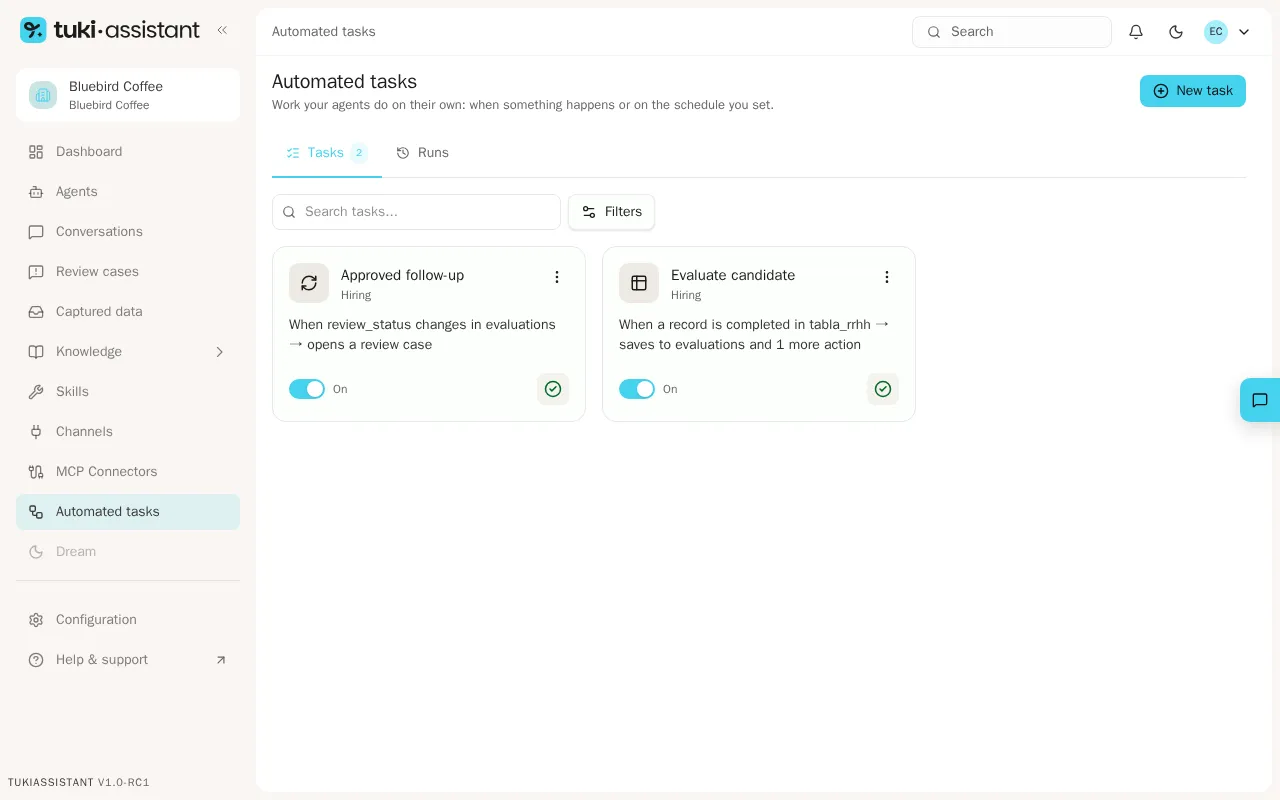
In Automated tasks each task is a card: it shows what triggers it and what it does, a switch to turn it on or pause it, and an indicator of its last run. Hover the indicator (or tap it on a phone) to see when it ran, the next run and, if it failed, the reason. If the last run of a task that is on failed, the card shows Needs attention. Use Filters to see only tasks that are on, off or need attention, of one agent or one type.
What it costs
Each run that calls the AI uses credits from your plan, like a conversation. Runs that do not meet the criterion use no credits. If an action fails and is retried, the AI is not charged again.